Why First Gear Is the Safest Choice for Tight Right and Left Turns
Why First Gear Is the Safest Choice for Tight Right and Left Turn
Learning how to drive safely is not just about passing the driving test. It is about developing habits that help you react correctly in real traffic situations and protect everyone around you.
One of the most important habits for learner drivers is understanding when to use first gear. Many new drivers approach a tight turn in second or even third gear, only to discover they are moving too fast to observe pedestrians, cyclists, and other vehicles properly.
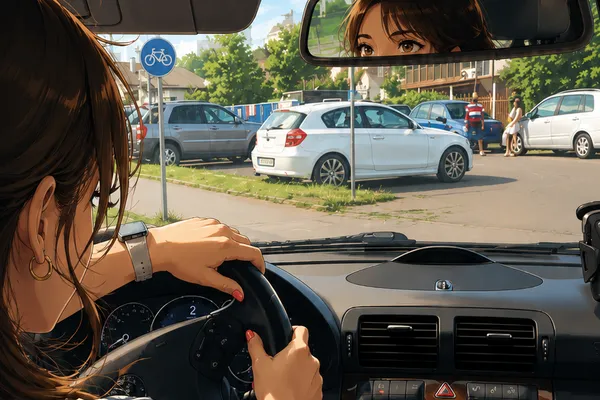
When making a tight right or left turn at a junction, especially where bicycle lanes, pedestrian crossings, or limited visibility are present, first gear is often the safest option
When Should You Use First Gear for a Turn
A tight turn should normally be taken in first gear when:
• A cyclist crosses the junction.
• When we turn right, we must always check for pedestrians. Don't forget that at the junctions the continuation of the sidewalk is a pedestrian crossing!
• Visibility is limited by parked vehicles, buildings, or other obstacles.
• The street is narrow.
• Traffic conditions require maximum control.
• The turn is particularly sharp or closed.
These situations demand precision, observation, and the ability to stop immediately if necessary.
Why Is First Gear Safer?
Better Vehicle Control
First gear provides maximum control at low speeds. The vehicle responds more precisely to steering inputs, allowing the driver to follow the correct trajectory throughout the turn.
This is particularly important when turning into narrow streets or when passing close to curbs, cyclists, or pedestrians.
More Time to React
Lower speed means more time to observe and react.
A cyclist may suddenly appear, or a pedestrian may step onto a crossing. By driving in first gear, you gain valuable extra seconds to identify hazards and respond safely.
Reduced Risk of Entering Oncoming Traffic
One of the most common mistakes among learner drivers is entering a turn too fast.
When this happens, the vehicle tends to follow a wider trajectory than intended. During a left turn, this can result in entering the oncoming lane. During a right turn, it may lead to crossing lane markings or cutting across areas reserved for cyclists.
First gear helps maintain a tighter, more accurate path through the turn.
Improved Observation
Safe driving requires constant observation.
Before and during the turn, drivers should check:
• Rear-view mirror.
• Side mirrors.
• Blind spots.
• Pedestrian crossings.
• Cyclists.
• Traffic signs.
• Oncoming vehicles.
Driving at a slower speed makes it easier to process all this information without rushing.
How to Downshift Before the Turn
Many learner drivers understand that first gear is safer for a tight turn, but they are unsure how to change down from second or third gear correctly.
The key principle is simple:
Complete the gear change before entering the turn.
If You Are Driving in Third Gear
1. Check your mirrors.
2. Release the accelerator.
3. Apply gentle braking to reduce speed.
4. Press the clutch pedal fully.
5. Shift from third gear to second gear.
6. Release the clutch smoothly.
If the junction requires an even lower speed, continue slowing down.
If First Gear Is Needed
Once your speed has reduced sufficiently:
1. Press the clutch pedal fully.
2. Shift from second gear to first gear.
3. Release the clutch slowly until you reach the biting point.
4. Prepare to enter the turn.
A good driver prepares the vehicle before reaching the turning point rather than trying to change gears while already turning.
Using the Clutch Correctly During the Turn
For very tight turns, especially in manual transmission vehicles, clutch control is crucial.
After selecting first gear:
1. Slowly release the clutch until you reach the biting point.
2. Hold the clutch at the biting point while entering and completing the turn.
3. Keep the vehicle moving at a slow and controlled speed.
4. Focus on observation, steering, pedestrians, cyclists, and other traffic.
5. Once the turn is completed and the steering wheel has been straightened, release the clutch fully and continue driving normally.
This technique helps:
• Prevent the engine from stalling.
• Maintain smooth vehicle movement.
• Improve low-speed control.
• Reduce the risk of sudden acceleration.
• Allow more precise positioning of the vehicle.
Practical Example
Imagine you are approaching a junction and need to make a right turn.
At the junction, there is:
• A cyclist crossing the road.
• A pedestrian crossing.
• Parked vehicles are limiting visibility.
If you attempt the turn in second gear, your speed may be too high to react comfortably if a cyclist or pedestrian appears unexpectedly.
Instead:
• Check your mirrors.
• Reduce your speed.
• Select first gear before the turn.
• Bring the clutch to the biting point.
• Maintain a slow and controlled speed through the maneuver.
• Straighten the steering wheel.
• Release the clutch fully once the vehicle is aligned with the new road.
This approach gives you maximum control and allows you to stop immediately if necessary.
Common Mistakes to Avoid
❌ Entering the turn too fast.
❌ Changing gears while already steering through the turn.
❌ Holding the clutch fully pressed throughout the maneuver.
❌ Selecting first gear at excessive speed.
❌ Failing to check bicycle lanes and pedestrian crossings.
❌ Looking only ahead and forgetting mirrors and blind spots.
A Simple Rule to Remember
When approaching a tight junction, follow this sequence:
Observe → Brake → Select First Gear → Find the Biting Point → Turn → Straighten the Steering Wheel → Release the Clutch Fully
This simple process helps learner drivers perform safer and smoother turns while maintaining complete control of the vehicle.
Final Thoughts
The objective of every turn is not simply to complete the maneuver but to complete it safely and predictably.
Whenever a right or left turn involves a bicycle lane, pedestrian crossing, limited visibility, or a narrow street, first gear provides the control, precision, and reaction time needed to protect yourself and other road users.
Remember: a turn taken slightly slower is usually much safer than a turn taken too fast. Safe driving is not about speed—it is about control.